
Pharma Industry Report ...
- Home >
- articles >
- electrical >
- engineering >
- rfid fda regulations
All about RFID systems for pharmaceutical distributors and the FDA regulations.
By Sangeeta of Abhisam Software
Abstract:
The US FDA has decided to implement the "Pedigree provisions" of the Prescription Drugs Marketing Act after December 2006, when the current stay on it expires. There is a lot of concern that many pharmaceutical supply chain participants, may not be able to meet this deadline and hence risk non compliance with the provisions of the act. This pharmaceutical article is excerpts from the RFID technology white papers written by Sangeeta of Abhisam Software. The RFID technology white papers attempts to present an RFID Systems solution to ensure timely compliance and get added side benefits in the process.
Problems with the present pharmaceutical supply chain:
There are two major problems with the present pharmaceutical supply chain model of the pharma industry, as it exists today. The first one is not of counterfeiting, but of diversion. More details will be explained in in the background information below and in Sangeeta's RFID technology white papers, but some highlights are below.
- Drug diversions can be of two types.
- Drugs meant for Medicare or Medicaid programs, public hospitals or charitable institutions, are diverted to the open market.
- Unscrupulous persons sell prescription drugs or "controlled" substances to consumers, without proper prescriptions.
- Counterfeiting (by FDA definition)
- Dummies/ Placebos, which means that there is no active ingredient at all
- Products with a lesser quantity of active ingredient than stated
- Products with the wrong active ingredient
- Products with a packaging that wrongly suggests that it was made by an FDA approved manufacturer
To give you an idea of the scale of the counterfeiting just one of these cases involves $42 million of counterfeit Lipitor. Other high value cases include a case involving a $200 million nationwide drug diversion conspiracy and a $45 million Medicaid fraud involving diversion of blood products.
The FDA's solution to the problem:
The FDA's vision of a safe and secure pharmaceutical supply chain is based on transparency and accountability by all participants in the (prescription drugs) pharmaceutical supply chain. The FDA had nominated a task force to study whether this system could be implemented with the currently available state of the technology.
They came to this conclusion after studying the various technologies currently commercially available, which could meet the pedigree requirements, including RFID or Radio Frequency Identification technology. Amongst all technologies studied including bar coding, RFID seemed to be the most promising and the committee felt that the pedigree requirement could be met by easily leveraging something that is readily available. (More details in the complete RFID technology white paper "RFID-FDA-Regulations.pdf" referenced below)
How the pharma companies can approach this issue:
The million dollar question is "Who can ensure an ROI on this RFID technology, especially after millions have already been spent?" Even if a full scale RFID implementation were done now, how can it be done fast, before the deadline?
Rather than resist implementation of a pedigree system built on RFID systems , pharmaceutical supply chain participants must realistically estimate the costs of investment in the technology, the real cost of counterfeits and the returns on a foolproof RFID based "track and trace" system. The RFID systems will virtually eliminate the counterfeit pharmaceutical market at one go. Secondly, it can ensure that drug recalls can be done swiftly without any ambiguity. This has been demonstrated many a times. Thirdly, the RFID systems need not cost too much.
How wholesalers and traders can implement track and trace:
Ditto for other pharmaceutical supply chain intermediaries. They can simply join the same global system outlined in the RFID technology white paper that is currently in place and implement the electronic pedigree system easily. The only investment would be in the RFID readers and middleware. Even these can be bought in bulk by their associations at negotiated prices and implemented. This solves the issue of RFID standards too, since all participants would be using similar kinds of RFID readers and RFID software.
Beneficial Side effects of the implementation:
In addition to combating pharmaceutical counterfeiting and diversion, pharmaceutical wholesalers, traders and retailers, get the added benefit of looking into their businesses and track the movement of prescription drugs with full transparency. This will no doubt yield added benefits of inventory optimization, demand forecasting and increasing their knowledge of what is selling and how fast.
RFID Implementation issues:
To implement this system fast, before the deadline of December approaches, it is essential to train all stakeholders (pharmaceutical company personnel, wholesalers, traders, retailers and others) fast but, at a competitive cost. However, the present cost of classroom based training is expensive, besides having other related costs like travel and hotel stay. A better system would be to go for a vendor-neutral e-learning program, which can be deployed immediately and across several locations simultaneously. See: https://bin95.com/vocational-training/barcode-rfid.htm
This has the effect of bringing up all staff, to a level necessary for them to implement an RFID based pedigree system. The e-learning program should cover all aspects of the RFID technology including the history, advantages over traditional automatic identification like bar codes, practical RFID systems, RFID standards and middleware as well as other issues like RFID privacy and RFID security. It should ideally also offer a self assessment and a glossary. We believe, that deploying such a program, across many companies is the only option to effectively train hundreds of people, in a cost-effective manner, so that the actual implementation of the system can be done smoothly. It is essential to bring all people on board, make them understand this RFID technology better and only then talk of implementing it.
Conclusion:
RFID track and trace is a technology whose time has come. It not only will meet the FDA requirements for compliance but also prevent pharmaceutical counterfeiting (lost opportunity sales of genuine drugs), prevent diversion, optimize pharmaceutical supply chains as well as fulfill social responsibilities of the pharmaceutical industry fraternity.
Training large numbers of people in a short time, is not a problem at all since a vendor-neutral, technology and implementation focused e-learning program is now easily available.
By Abhisam Software
Some Additional Background Information ...
Pharmaceutical distributors Background :
The Prescription Drug Marketing Act (PDMA) was signed as a law, as far back as 1998 but a number of amendments introduced later, finalized the pedigree requirements only in 1999.
The pharmaceutical industry, essentially requesting them to the act "put on hold" , citing several reasons for this, one of them being "the technology required for this system is unproven and not in place." The FDA patience finally wore thin. Therefore it was decided that they will allow the current stay on this act, to expire in December 2006.
This may not be a big problem for the pharmaceutical manufacturers, but it could be a really big problem for supply chain intermediaries like distributors, pharmaceutical wholesale suppliers and traders, who may not know much about "electronic track and trace" technology, which is necessary for the compliance. Sangeeta's RFID technology white paper attempts to explain how this RFID track and trace system can be implemented and how it will be beneficial in the long run to all sections of society- pharmaceutical companies as well as intermediaries and ultimately the end users.
Understanding the pharmaceutical supply chain:
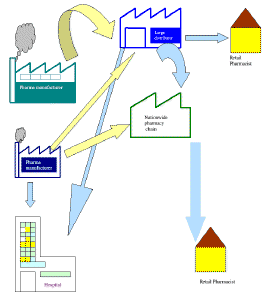
The lay reader may assume that it is like any other supply chain, which brings goods from the manufacturers' factories to the retail shelves, but it is not so. The pharmaceutical supply chain is inherently different in its organization. For the pharmaceutical business, the pricing for each end user is different. Therefore a typical hospital gets these drugs at lower rates than does a corner pharmacy. There are programs like Medicare and Medicaid where the procurement prices are different than for someone who buys the same drug at a corner pharmacy. The pharmaceutical distributors diagram to the right shows some of the various flows of prescription drugs through the pharmaceutical supply chain. (More details in Abhisam RFID technology white papers like "RFID-FDA-Regulations.pdf")
| Download the complete RFID technology white paper RFID-FDA-Regulations.pdf, please right click on link and select "Save Target As". Thank you for your interest. |