
PLC SCADA Training Programs
- Home >
- vocational-training >
- plc-training >
- online >
- control systems technology
Certificate in Programmable Logic Controllers (PLCs) and SCADA Systems
This NEW approach to earning our PLC SCADA Course Certificate (4.2CEU) is better than other Online PLC SCADA courses ...
Take the courses on your own time, on your own schedule!
Less than 1/6 the cost of a traditional 3-month online PLC SCADA course
Take as much time as you need
No internet access is required while taking the course
For clarity, PLC and SCADA are two separate courses.
The only PLC SCADA course you can do at home/work and still get real-world troubleshooting experience.
Difference Summary: This PLC SCADA course is Basic only, focused on a maintenance perspective, costs less time and money, and is more convenient than traditional online courses.
Note: While the PLC SCADA courses on this page are the basics, the topic itself of "SCADA programming" and some of the PLC programming topics covered like "Analog Scaling", are more advanced topics than just PLC basics.
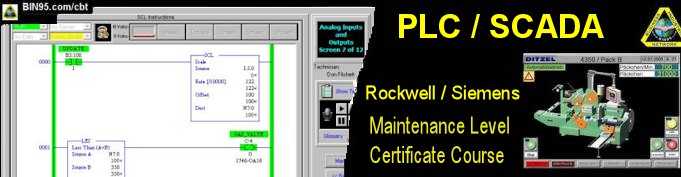
Bundled: PLC Training Software and SCADA Basics Course (<< click for details of each course)
Order now with add to cart button below. Start your PLC SCADA course within 24 hours!
This PLC SCADA Training course never expires, so use it as a refresher any time!
You will receive an email with the download and instructions within 24 hours.
Select single student or unlimited student site license.

PLC SCADA course descriptions...
PLC Basics Intro
Input/Output Modules
Safety Circuit
PLC Processors
Numbering Systems & Codes
Basic PLC Programming
Timer Instructions
Counter Instructions
Program Control Instructions
Data Manipulation
Math Functions
Shift Registers & Sequencers
Analog Inputs & Outputs
Networks
Human Machine Interfaces
Troubleshooting PLCs
Introduction to SCADA
What is WinCC?
Creating a new project in WinCC on a single standalone PC
Creating tags
Creating a connection to a PLC (using S7-PLCSIM simulator)
Using the Graphics Designer
Configuring alarms and displaying them
Industrial Network Security
8 Tests throughout course
1 real-world hands-on task with real SDADA software
Two challenges, (1 uses real SCADA software you download for free!)
Customer Comments:
"I am an Electrical Engineer who wanted to further my knowledge and understanding of PLCs. After searching for a course locally all that was on offer were long drawn-out courses. BIN95 has offered an excellent learning method where you can complete modules at your own pace, however fast or slow you like. The course content has far exceeded my expectations and I would recommend BIN95 to anyone looking to learn more about Industrial Automation." - Sam Stevenson
"This training is worth it and beneficial. PAC is my next goal for training." RJ Moore - Lawrenceville, GA
Audience: Engineers, Electricians, Maintenance, and all those who want to understand PLC and SCADA systems and want to get a solid appreciation of the fundamentals of working with and troubleshooting PLC SCADA systems
To fully understand SCADA, you need to know PLCs (Programmable Logic Controllers) first!
PLC and SCADA Course Certificate:
Combine successful completion of both the PLC course and the SCADA course on this page to result in you receiving the 4.2 CEU PLC SCADA course Certificate. You can order these two required courses separately elsewhere on this site, or purchase both as a bundle on this page to save even more!

PLC and SCADA course certificate REQUIREMENTS:
Email a copy of your PLC training software course certificate.
Complete all tests at https://bin95.com/plc-scada-training-online.htm while you copy SCADA @ bin95.com on test results.
Complete the 'Training Task' on slide 70 of the SCADA course.
Learning Path:
We recommend:
1st Industrial Electrical Training Video Course (10 DVD Set w/ workbook)
2nd Electrical Motor and Controls Course
3rd PLC Basics (included in the bundle on this page)
4th HMI Basics
5th PAC - Controllogix and RSLogix 5000
6th PLC Training scholastic Video Course (10 DVD Set w/ workbook)
7th Online PLC Structured Text Programming Basics Course
8th PLC & SCADA Basics (The page you are on now)
Related Maintenance Training Bundle:
The PLC Technician
ALSO, SEE ...
"Siemens PLC Training Simulators "
"PID Tuning Simulator and Blueprint"
"DeviceNet Certificate Course"
"OPC Training Certificate Course"