
- Home >
- articles >
- maintenance-management >
- maintenance management plc
Maintenance Management of your company's PLC
Maintenance management of Programmable Logic Controllers and other industrial automation.
By Don Fitchett
(This article originally featured in Chemical Engineering Magazine, updated 6/27/2024)
What is a PLC?
How many PLCs is your Bottom line depending on?
Do you have an up-to-date list of all PLC model types, part availability, program copies, and details for your company?
Do you have At least one trained person per shift to maintain and troubleshoot your plant PLCs?
Does your maintenance personnel work with PLCs following written company or corporate policy and procedures?
Suppose you cannot answer confidently or answer "No" to any of the above questions. In that case, you must read this article about a PLC maintenance management. Why? Because the PLCs (Programmable Logic Controllers) are the brains of your operation. When the control system is not functioning properly, lines shut down, plants shut down, and even city bridges and water stations could cease to operate. Just one little PLC loses thousands to millions in an electrical panel you never knew existed. But most importantly, damage to machines and personnel could result from improper maintenance management of your company's control system.
 What is a PLC?
First, I'd like to explain it in the most non-technical terms possible. This article is not just for the maintenance technician but for maintenance managers, plant managers, and corporate managers. A Programmable Logic Controller is the type of computer that controls most machines today. They are used to both control AND troubleshoot the machine. The controller is the brain of the machine. Without it, the machine is dead. The maintenance technicians we train are the brain surgeons. That is also how I explain it to my doctor. (His mouth drops open, "... you train brain surgeons?") 
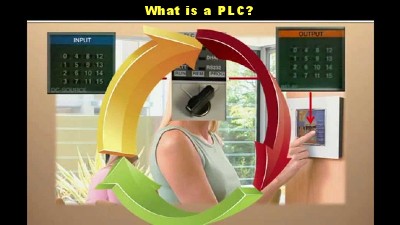
Just as a doctor asks the patient questions to determine what is wrong, a maintenance technician asks the automation control system questions to troubleshoot the machine. The maintenance technician uses a laptop computer to see what input and output devices are required for the PLC to cause an action (like turning a motor on). In a reliable maintenance management system, the maintenance technician will use the Programmable Logic Controller as a troubleshooting tool to reduce downtime.
A more detailed definition: A programmable controller is a small industrial-strength computer that controls real-world actions based on its program and sensors. The logic controller replaces thousands of relays in older electrical panels and allows the maintenance technician to change how a machine works without having to do any wiring. The programming language is typically ladder logic, similar to the wiring schematics maintenance electricians already know. Inputs to a controller can be switches, sensors, bar codes, and machine operator data, to name a few. Outputs from the PLC can be motors, air solenoids, indicator lights, and others.
How many PLCs is your Bottom line depending on?
My company has had an ongoing maintenance costs survey since 2000. The majority of the participants, back in 2001, reported 3-6 PLCs in their facility that they know of. Granted, most participants are managers and don't open electrical panels much, but many are from Fortune 500 companies with hundreds of employees. The odds are that most of them have 12-30 PLCs in their facilities. Currently, the average is 10-20 reported, so the good news is that the industry as a whole is becoming more aware.
It is common to only learn about a particular control system once the machine is down and the clock is ticking at a thousand dollars an hour or more. Unfortunately, it is often the case that after the fire is out, it's on to the subsequent fires without thoroughly learning what is needed to avoid these costly downtimes in the future and other similar machines in a company or corporation.
Some older electrical panels may only have relays, but a PLC controls most machines. A bottleneck machine in your facility may have an automation controller. Most plant air compressors do. How much would it cost if the bottleneck or plant air shut down a line, a section of your facility, or even the entire plant?
Do you have an up-to-date list of all Automation Controller model types, part availability, program copies, and details for your company?
Various types of maintenance management strategies involve the use of automation. With IoT and big data initiatives, the role and the risk are ever-increasing. Which, in turn, increases the importance of automation control system audit and management. Below are four examples.
1. Preventive Maintenance:
Managers can set up alerts for routine maintenance. You can base the alerts on runtime or calendar. When it comes to PdM, companies save time and money.
2. Predictive Maintenance:
The PLC collects and analyzes data on equipment performance. This data enables maintenance managers to see patterns and trends. These may show potential issues and opportunities to reduce downtime.
3. Condition-Based Maintenance:
The automation controls gather data on many parameters, including temperature, pressure, and vibration. They let managers assess equipment health in real-time. Also, it frees up personnel and test equipment.
4. Reliability-Centered Maintenance:
The final data computation to make RCM reports needs lots of memory and processor time. IIoT sensors send data to computers for advanced calculation processing. The PLC will deliver data to the computer from the non-IIoT sensors within the machine, line, or plant.
The examples of the four types of maintenance strategies clarify the growing need to maintain your automation control systems audit.
The first sep to take is to perform an audit. Open every electrical panel and write the automation controller brand, model, and other pertinent information. Then, go the following two steps. Analyze the audit information and risk, then act on that analysis. To help you out, I want to share our company PLC audit form with you.
Collected Information
Recommended Action
Machine or Area Name
Ex: warehouse conveyor, pump station 3, Strapper 2, Line 7, Traffic signal west main.
PLC Program Name
Ex: 1789GAA1, P3, Strap2, 5872443, WestMainTL.
Required Software
Ex: RSLogix 500 & RSLinx (or Studio 5000 & FactoryTalk), are they accessible? etc.
Programming Language
Ex: Ladder Logix, Structured Text, G-code, C++, Python, Java, etc.
Communication Protocols
Ex: Ethernet, DB9/RS232, RJ45, are cables available? etc.
Network Node Address
All addresses will be different. Ex: 2, 3, 17, 21, 192.168.1.x
Network Name
It is often the same as the Program name, but it is not mandatory.
Controller Brand
Ex: Allen Bradley, Siemens, Schneider, Mitsubishi, DirectSoft, Omron
Model Number
Ex: PLC-5/25, SLC-504, SIMATIC S5, MELSEC FX1N, DL 405
Is a Spare Available?
Yes, in less critical machines, no.
Date Program Last Backed Up
Make program backups part of your semiannual PM program.
Is a Discriptored Program available?
Without a discriptored copy of the program, troubleshooting and downtime increase significantly.
Does the controller have an EEPROM
Another method of storing a backup program in a chip on the controller itself. (Could be flash memory or other)
Last date Program Changed
Remember to log when outside consultants or OEMs make program changes.
Last date EEPROM Burned
Save to EEPROM (Burned) after every successful program change.
The date the battery was last changed
See the manufacturer's data for recommended change frequency.
Other information you may need
For example, 'facility location' when corporate HQ uses this form.
Once you have collected the essential information in your plant or corporate audit, you need to analyze the data to develop an action plan based on risk analysis. In the risk analysis, bottlenecks and other factors will help you assess priorities. Your Computerized Maintenance Management Software or other maintenance management system should help if it already has individual machine criticality ranks determined. Starting with the highest priority control system, you must ask more critical questions.
O Do we have the most common spares for the controller?
O Is the OEM (Original Equipment Manufacturer) available 24/7? Or even in business anymore?
O Do we have a backup copy of the program?
O Does our program copy have descriptions so we can work with it reliably and efficiently?
O Do we have the software needed to view the controller program? Are our maintenance personnel trained on that brand?
These are some of the questions our managers must ask to avoid unnecessary risk and to ensure reliability.
Tip: Place a higher priority on A PLC system power supply than DC for reliability reasons. (Read Controller Failure Rate for more insight on what spares to stock and quantity.)
Do you have At least one trained person per shift to maintain and troubleshoot your plant Automation Controllers?
Is your maintenance staff trained on the programmable automation controller? It is silly to squander over a couple thousand in maintenance training costs when the lack of Proper PLC Training could cost you 10 thousand an hour. ... or worse. Here are a couple of reasons you should have at least one trained person per shift to work reliably with your automation control. You want to avoid seeing more significant downtime on off shifts because the knowledge base is on the day shift only. Also, with all the baby boomers (our core knowledge base in the industry) retiring, it is risky asset management to place all your eggs in one basket.
What should we look for in training? have been training individuals for over a decade and could write another article on PLC training alone. Here, you should seek training with two primary objectives.
1. The training you decide on should stress working with PLCs safely and reliably. (not just textbook knowledge or self-learned knowledge)
2. Secondly, the training should center around the products you use or plan to use in your facility.
The two criteria above are the most important. Another good idea to get more out of your training investment would be hands-on training using the actual PLC programs and software the maintenance technician will work on within the facility. Ensure your personnel has the software, equipment, and encouragement to continue with self-education. PLC Training Course software is an excellent way for employees to follow up six months after the initial training. Some other ideas you could do is to provide them with simulation software or a spare controller off the shelf to practice with.
Does your maintenance personnel work with PLCs following written Company or corporate policy and procedures?
In our industrial culture, if policies and procedures are not written and enforced, we eventually return to the old, unreliable ways. I have reviewed many policies, procedures, and books on the topic and have yet to see the maintenance management of the automation controllers included. It amazes me how an organization can write guidelines for what they believe is the health of the entire organization's body and leave out the brain (the PLC). Once again, a complete automation control policy and procedure manual is out of the scope of this article. However, I will donate a few random items below to get you started.
- Write PLC policies and procedures into our existing maintenance policy and procedures. (SOP)
- Train all personnel working with automation equipment.
- The best practice is to make backup copies of the PLC programs every six months regardless of the change status.
- Actions to take after a Programmable Logic Controller program is modified:
- Document changes in the copy of software (Revision Notes), the printed copy, and the CMMS program.
- Copies of the control programs are stored on a media more reliably than on a floppy disk and stored on USB instead).
- Store multiple copies on the laptop, the maintenance manager's office, and off-site (corporate).
- Update EEPROM with the newly changed program.
- If an outside vendor changes the program, maintenance personnel must perform a-d above.
- For future equipment purchases:
- The same controller brand in all equipment will be the goal (Standardization of all automation.)
- OEM must provide a descriptor copy of programs in the customer's native language.
- All PLC 110v control voltage will have a line filter on it.
- All automation controls will have the backup EEPROM or Flash memory option for zero downtime in some failure modes.
- Forcing inputs and outputs to be on or off shall be treated as a Safety issue. (See safety SOP)
- Inputs and output devices forced on or off should be done only as a last resort. Deciding to force I/O can only be made with a clear understanding of the complete effect of the force on the program and process. Also, a second opinion is strongly encouraged.
- Installing forces in automation controllers should be a rare event. Within 24 hours, find a more permanent solution and remove force.
- Document all forces in software in a log before being enabled.
- Online programming is a safety risk. The standard procedure is to change it offline and download it to the Programmable Logic Controller.
Whatever computerized maintenance management systems you are using, there should be a mechanism you can start to implement the advice given here. I hope this helps. If you have a specific question, you can find me on LinkedIn.
Don Fitchett (President)
Business Industrial Network
PLC Training - The Best for Less
To print this page, click https://bin95.commaintenance_management_plc_print.pdf
Our instructors teach this kind of valuable money-saving, safety, and reliability information.
Request a quote for onsite PLC Training today!
Also, see our Troubleshooting PLC Control Circuits training software.
| Need more in-depth PLC training with no trail cost? Please see our Automation Control Training Bundle. |
|
 Online HMI SCADA and PLC Course
Feel free to copy and distribute this article if you let us know first and maintain all credits/ links above.